Tuesday, May 11, 2010

Saturday, May 8, 2010
Artist refs: Contemporary Tessalating
I am interested to see how various artists around the globe end up making similar statements without direct communication with each other initially. This will be the subject on my Interprative article. A common hteme is the link between, 2D trianble geometry, that builds to 3D cubes, then heaxogons, then a further elaboration is the use of tesselation.
Olafur Eliasson: http://www.olafureliasson.net/works.html
Raewyn : (3rd year student Unitec)
 Justin Marshall
  Andrea Bugli

Olafur Eliasson: http://www.olafureliasson.net/works.html
Raewyn : (3rd year student Unitec)
Justin Marshall Andrea BugliArtist ref: Jason Martin
 My im
My im mediate response to his highly textural and often reflective or translucent work is to spend some time exploring the various textures and techniques he employs for my own purposes. My next project Compound I requires a wide variety of surfaces, treatments and reflective properties to express a myriad of experiences.
  I also note the use of the square, or cube format, common to artists dealing with primary themes. The main technique involved here is the dragging of a 'comb' through heavily applied oil paint. The first practical item that springs to mind is what the drying time and of the need for adequate ventilation! My poor room mates. Dont think - just do.
Doing
 After all the brain lightening, I need to get on with the practicalities of doing, which at this point involves working out a size for my tessellated isometric cubes bearing in mind the size of the raw material - custom wood. It is my intention to utilise off cuts from building sites and the like.
Friday, May 7, 2010
Compound I : New Project
 The mathematically logical extension of the triangles leads us to cubes - a metaphor for space, the media in which we create. Although my reading on such subjects has been confined to Western popular science journals, I was pleased to read in the course readings about the Tongan concept of time and space, ta and va, and of the beating of ta, and the need to nurture the space.
Folding the triangles through another dimension creates cubes, a fundamental metaphor for space, the media in which hall happens. It brings to mind the Kaaba -the empty space enclosed by a cubic structure that is at the heart of Muslim representations of the Creator.
 Malevich in his separatist manifesto saw the black square in a similar fashion. I find I am fascinated by the isometric cube with its ambiguous presence. Is is empty or full. This is a suitable metaphor for the fullness and emptiness in one concept of a number of faiths. When the points are counted, they number 6, which conveniently matches the structure of the carbon atom - the building block of all life. With this basic media established, I intend to launch on a celebration of all life. Additional input for Richard Fahey my tutor, regarding the possibility of tessellating these forms in the manner of the Romans and Venetians, in which they are interlocked into each other is a very exciting one that opens the possibilities to creating a larger effect on another scale. I am intrigued by the use of tessellating by modern artists such as Justin Marshall.
http://www.justinmarshall.co.uk/process%20pages/tilesprocess.html
The notion of creating a large work that is composed of many tessellated parts, at varying scales, that might produce a whole more than the sum of the parts is very exciting and challenging. I can also draw links to the work of Keith Tyson, whose Wide Field Array project which is composed of many small parts in order to convey a bigger message. Tyson was inspired by the application of a large number of smaller telescopes arranged in a grid in order order to capture a bigger picture. http://www.keithtyson.com/#/projects/largefieldarray/exhibitions/
When isometric cubes are tesselated, their immediate resemblance to what we think a fly might see with its compound eye immediately produced the trully satisfying pun : Compound I, an excellent platform from which to celebrate all of life as it emerges from a common source. The gaze of God if you will.
Perpertual Origami : Finished
 I am pleased that this piece conveys well my original vision of continuously folding planes of geometry as well as overjoyed at the final effect. The various facets and unfinished creases provided and endless play of light and animation for the viewer that was unexpected. This aspect alone is worth further investigation in the future.
 I will be pleased to see how this piece responds in different lighting conditions. I am immediately struck by its resemblance in essence to Picasso's Gurnica, and the work of Escher as well as Gaudi. An excellent suggestion by Karl (tutor) to do 2 more works at a much larger scale were thwarted by the limitations of the available PVC sheets. Should I locate a larger sheet size, I would continue this thread to exploit the warping properties of the PVC. There are endless possibilities to record due to the warping and reflective nature of the surfaced. I am very tempted to take to piece into different sites to record what happens in the reflection.
 For more details of this work go to:
http://www.flickr.com/photos/12d-into-2/sets/72157623891489177/show/
Applying top layer
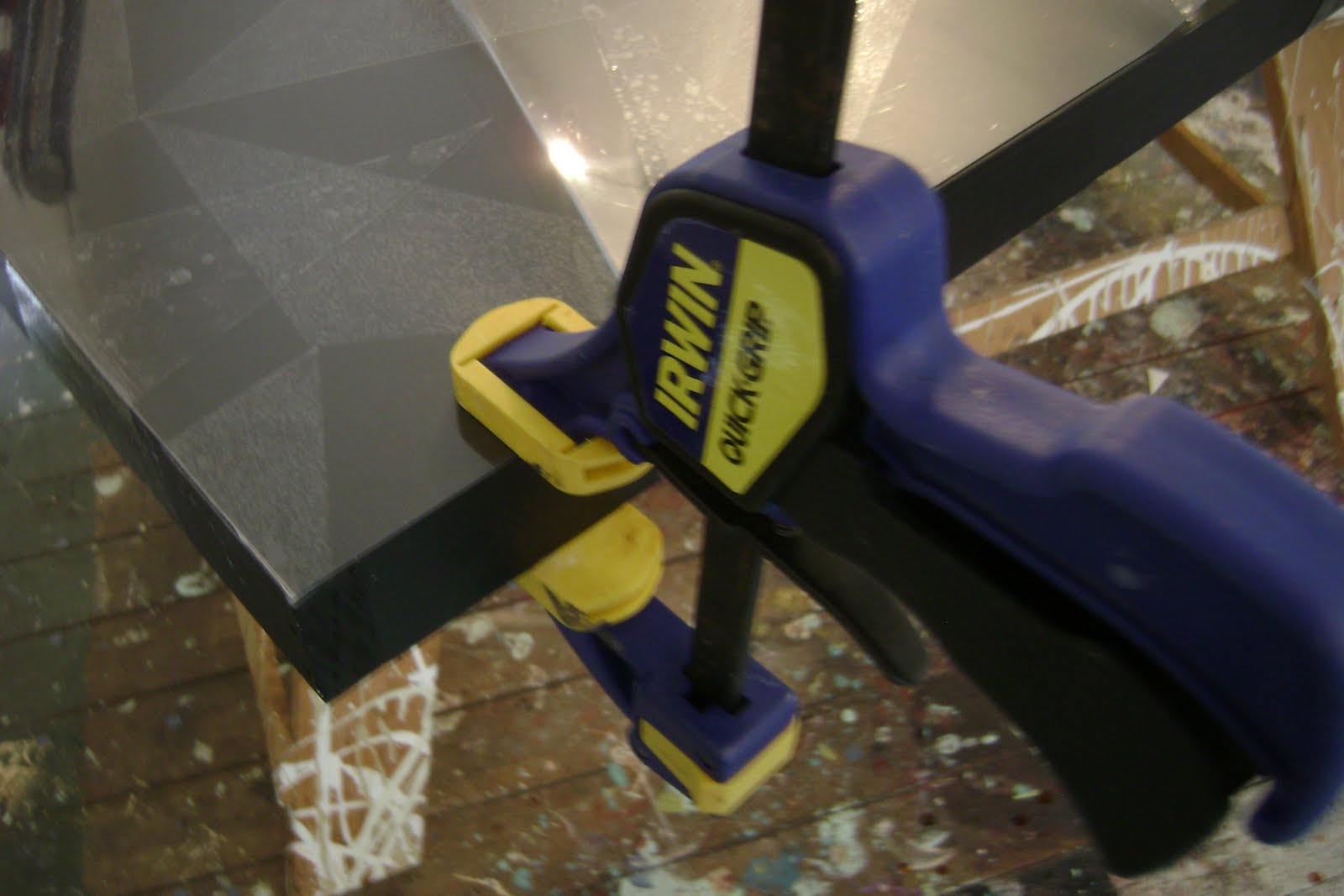 Creasing: The final layer to this project involves the creasing and attachment of the PVC sheet that takes on a faceted appearance.
Clamps were useful for stretching the sheet to overcome the tendency to shrink away from the board edges due to the creases.
Attachment: I had pondered endlessly in my mind about how to attach the PVC sheet to the board without solution. while poised with the final vinyl triangle, it occured to me in a flash that the obvious answer is to use the vinyl triangles them selves to attach the sheet to the board. It is tempting to call this the vinyl solution. I am
 overjoyed at the final effect especially as I worked out a method of creating a crease that penetrates only part way into the sheet so that we feel we are witnessing a process of becoming. The warps created by the creases provide an endless play on the light arriving at the sheet when the viewer changes position. This creates a liveliness and sense of energetic animation I did not anticipated.
Monday, May 3, 2010
Perpetual Origami : project : applying
 Methods: Earlier experiments with different surfaces confirmed that the a roller would produce the correct type of texture as required by my concept. The paint is spirit based blackboard paint. Next time I will use acrylic based paint for the quicker drying and easy clean properties. Discovery: When taking the picture right, I noticed that I cannot seem to take a random picture to save myself, I am always compelled to compose it for maximum effect- of
 ten producing pleasing results that can inform future projects. Another discovery (by doing!) was the accidental marks left beneath the adhesive which could be explored further as a potential source of subtle imagery. However, for this current project, an even texture is required- the image being whatever is reflected in on the surface itself. I wonder how many people will pick up that intention? The final effect created before the application of the top layer is attractive in itself. At this point I am aware that something magical nearly always happens to the perception of preparatory work such as tracings and sketches once they are pictured and cropped - appearing as finished works.
Perpetual Origami : project : plotting
 This is the piece in progress at the time of feedback received. With renewed energy, I flew into it production of and soon became engaged with the problem solving required to bring this project to completion. Modeling of the triangles became important in order to portray isosceles triangles accurately and to compose effectively. I did toy for a while with the idea of a more random set of triangles, but soon rejected it in favour of a reductionist a
 ttitude in keeping with the fundamental nature of the content. different compositional problems were solved by subsequent tracings, simplifications, allowances for dark and light shapes catere
 d for. This was all a powerful reminder of the exhortation of the tutors to learn by doing and not thinking. It has to be accepted that graphics with its concern for spending other people's money can act as a inhibitor and that i
 t will take time to rehabilitate my 'responsible' instincts. A final clean copy was completed before committing to cutting and laying of the songwriter vinyl adhesive.
Direction correction : Kristy
 The essence of the feedback from tutors was: less reading and thinking and more doing. Having spent 30 years in graphics, I sense I am becoming bogged down in this triangle/geometry based project that does not seem to represent my previous free somewhat Pollock-like work. It was however in my
  mental in tray to be expressed and must represent some fundamental place 'space making' process I need to go though before playing again with more free flowing elements. I accept that there has to be a media, a stage, a medium, for the creation to occur in. Kristy's suggestion that I find a way to bring the two elements of 'self' together, extreme order and play, were gratefully received. Doing this would represent an integration of the two sides of my nature. >>insert sketch of 4 layer project<< This promted me to consider bringing hte elements together as represented in the sketch.
Large Field Array exhibition : Keith Tyson
This exhibition entails a large number of smaller works representing a range of mediums. A dominant feature of the work is the reliance upon the cube as a format for expressing a wide range of ideas related to deep level order in nature, overwhelming diversity arranged in a grid system. Array refers to to notion of many smaller componants providing a bigger picture - reference is made to pixels, and telscopes arranged in an array. A notable feature of the opening page is the the use of the isometric cubes arranged on a grid that mimics the exhibition proper as a means of placing the objects in relationship to each other as well as in time.
http://www.keithtyson.com/#/projects/largefieldarray/examples, I am immediately struck by the use of isometric cubes as a format for both relating and expressing ideas. I have for some time signalled my own intention to make use of the isometric cube to explore ideas of deep level subject matter taking place within space, respresented by the cube - itself composed of fundamental elaboration of triangles. The use of a standard format over the coming months will allow me to commit to a series of conceptual and making porcesses without constantly reinventing a format. Even the lamp shade in my studio betrays my fascination with the cube.
http://www.keithtyson.com/#/projects/largefieldarray/examples, I am immediately struck by the use of isometric cubes as a format for both relating and expressing ideas. I have for some time signalled my own intention to make use of the isometric cube to explore ideas of
 deep level subject matter taking place within space, respresented by the cube - itself composed of fundamental elaboration of triangles. The use of a standard format over the coming months will allow me to commit to a series of conceptual and making porcesses without constantly reinventing a format. Even the lamp shade in my studio betrays my fascination with the cube.
Artist ref: Keith Tyson

Keith Tyson (English, metaphysical, 'mad' scientist treatise, http://www.keithtyson.com/ ). When entering his website I am immediately startled to find that the opening animation sequence bears a strong resemblance in intention and appearance to one of my own works, Non (right).

Of his nature series of paintings, in reference to the chemical process aspect of his work he declares, "...the significant aspect of the series is not that they are paintings of nature, but are painted by nature." I concur with this sentiment and will explore this 'man inside nature' notion in a later exploration (working title Leaf City) that restores man to a position inside nature as opposed to 'out' of it as established during the Enlightenment. I am further struck by the similarity between our notions of presenting an idea within a isometric cube. In Large Field Array, a device which locates a body of Tyson's work in relation to each other and time, use is made of the isometric cube as a format in which to express ideas. I have for some time signalled my intention to make use of the isometric cube to explore ideas of deep level subject matter taking place inside space represented by the cube. The use of standard format allows me to commit to a series of explorations without constantly reinventing a format.
Sunday, April 25, 2010
Feedback from tutors
Valuable feedback has just been offered by tutors that reorientates my intentions towards the making aspect of art - that de-emphasizes the thinking apsect of art. Here I explore the references offerd and wil later present results of my own investigations in an attempt to cryistalize the 'proposition.' Clarity is also offered in regard to direction taken in that I must for the purposes of the degree process curb a tendancy to explore tangents unrelated to my main proposition. I intend to park these divergant interests under the title of 'to be explored at a future date.' The following posts will explore the sources as suggested by the tutors.
Monday, April 19, 2010
Artist ref: Franz Marc : on abstract art
"..the entirely spiritualized and dematerialized inwardness of sensation."
A History of 20th Century. Bernard Blistene. ArtBeaux Arts.
Comment: I can relate strongly to this, as the inner field of sensation expands day to day.
A History of 20th Century. Bernard Blistene. ArtBeaux Arts.
Comment: I can relate strongly to this, as the inner field of sensation expands day to day.
Artist ref: Antoni Gaudi
"Mediated by man, creation continues unabated. But man does not create: he discovers." A History of 20th Century. Bernard Blistene. ArtBeaux Arts.
Comment: This fits with my concept that man is some kind of feedback system for 'Being" to express and understand itself. So in fact we are a kind of printing process, expressing things that already exist in a field of all possibilities.
Comment: This fits with my concept that man is some kind of feedback system for 'Being" to express and understand itself. So in fact we are a kind of printing process, expressing things that already exist in a field of all possibilities.
Artist ref: Piet Mondrian
...when adopting the cubist ideom and "his majestic struggle to break with the natural appearances." A History of 20th Century. Bernard Blistene. ArtBeaux Arts. Comment: Relating this to my own work, attempting to become aware of 'space making' that underlies the created world. I am left wondering if this initiative was an attempt to reach beyond matter to the meeting point between mind and matter, the elements and energy behind 'things.'
I also noted the reduction to primary colours that are a feature of my work: black, gold and silver.
My practice: I can relate to the sentiments here easily, but remain commited to using 21st century products to reflect the times we live in.
Comment: Relating this to my own work, attempting to become aware of 'space making' that underlies the created world. I am left wondering if this initiative was an attempt to reach beyond matter to the meeting point between mind and matter, the elements and energy behind 'things.'I also noted the reduction to primary colours that are a feature of my work: black, gold and silver.
My practice: I can relate to the sentiments here easily, but remain commited to using 21st century products to reflect the times we live in.
Poet ref: Apollinaire
"They (cubists) share with the artists of academe the same mania for painting states of mind"A History of 20th Century. Bernard Blistene. ArtBeaux Arts.
Comment: I related instantly to this notion, that there is a vast array on mind states to be explored and communicated to others. In my terms mind does not refer only to the local mind of an individual but also the universal mind in which we all exist.
Comment: I related instantly to this notion, that there is a vast array on mind states to be explored and communicated to others. In my terms mind does not refer only to the local mind of an individual but also the universal mind in which we all exist.
Subscribe to:
Posts (Atom)